What does a website development agency do for D2C brands in the US?
A website development agency for D2C brands in the US builds, optimises, and maintains the digital storefront that drives direct revenue — from Shopify and custom-coded storefronts to landing pages, product pages, and checkout flows. Unlike generic web studios, a specialist D2C development agency focuses on conversion rate, page speed, mobile UX, and brand storytelling simultaneously. HavStrategy works exclusively with direct-to-consumer brands in fashion, beauty, skincare, lifestyle, luxury, and jewellery, building websites where every element — from hero imagery to add-to-cart placement — is engineered to reduce drop-off and increase average order value. Book a discovery call to audit your current site.
How much does website development cost for a D2C brand in the US?
Website development costs for D2C brands in the US typically range from $5,000–$15,000 for a Shopify-based build with custom design, to $25,000–$80,000+ for a fully bespoke, headless commerce build. Factors that move the price include product catalogue size, custom functionality (quizzes, virtual try-ons, subscription flows), third-party integrations, and whether copywriting and photography are in scope. Most fashion and skincare brands investing in a high-converting DTC storefront see the build cost recovered within two to four months when paired with the right paid media strategy. HavStrategy offers transparent, scoped proposals — contact the team for a no-obligation estimate tailored to your brand.
How long does it take to build a website for an ecommerce brand in the US?
A Shopify or Shopify Plus website for a D2C brand in the US typically takes four to ten weeks from strategy brief to go-live, depending on the number of pages, custom feature requirements, and how quickly the client provides assets. Headless builds or custom-coded platforms can run twelve to twenty weeks. HavStrategy follows a structured sprint process — discovery, wireframes, design approval, development, QA, and launch — so timelines are predictable rather than open-ended. Brands that have all photography, copy, and product data ready at kick-off consistently launch faster. Reach out to receive a project timeline scoped to your specific requirements.
What is the best website platform for D2C fashion brands in the US?
Shopify and Shopify Plus are the dominant choices for D2C fashion brands in the US because of their ecosystem of apps, reliable checkout, and strong developer community. Shopify Plus suits brands processing above $1M annually and needing advanced checkout customisation, wholesale channels, or multi-currency selling. For luxury or jewellery brands where bespoke storytelling and animation matter, a headless build on a React front-end with a Shopify or custom back-end often delivers better creative control. HavStrategy has built across all major platforms and recommends based on your revenue stage, product complexity, and team's technical capacity — not on platform commissions. Schedule a platform consultation to find the right fit.
What makes a high-converting website for a skincare brand in the US?
A high-converting skincare website in the US balances trust-building content with frictionless purchase flows. Key elements include clinical claim presentation (ingredients, certifications, before/after imagery), mobile-first page speed under 2.5 seconds, a streamlined checkout with express payment options, and personalisation touchpoints such as skin-type quizzes. Brands that invest in robust product description pages with video, UGC, and FAQ modules typically see conversion rates of 2.5–5% versus an industry average closer to 1.5–2%. HavStrategy designs skincare storefronts that align brand identity with commercial intent — every visual and UX decision is tied to a measurable outcome. Request a free CRO audit of your current website.
How does website development affect SEO for ecommerce brands in the US?
Website development directly determines how well an ecommerce brand ranks in the US because technical SEO is built at the code level — site architecture, URL structure, schema markup, Core Web Vitals, crawlability, and internal linking are all development decisions. A poorly built Shopify site with duplicate collection pages, slow load times, or unoptimised image delivery can suppress rankings regardless of how strong the content strategy is. HavStrategy integrates SEO requirements into the development brief from day one, not as a post-launch afterthought, which typically reduces technical remediation costs by 30–50%. Ask about the combined website development and SEO packages available for US-based D2C brands.
Can a website development agency help a jewellery brand increase online sales in the US?
Yes — for jewellery brands, the website is the single highest-leverage asset in the DTC growth stack. A specialist agency builds product pages that replicate the tactile experience of in-store browsing: 360-degree product views, high-resolution zoom, metal and gemstone variation selectors, size guides, and editorial lifestyle photography. Beyond aesthetics, the agency optimises for the jewellery buyer's longer consideration window — wishlist functionality, gift occasion filtering, and jewellery care content that keeps browsers returning. HavStrategy has worked with jewellery and luxury brands across the US, UAE, and UK, building storefronts that convert both impulse and considered purchasers. Book a jewellery-specific website review today.
What is the ROI of investing in a new website for a D2C lifestyle brand in the US?
The ROI of a website rebuild for a D2C lifestyle brand in the US depends on baseline conversion rate and traffic volume, but brands that move from a template-built site to a purpose-designed, conversion-optimised storefront typically see conversion rate improvements of 30–80% within the first six months. On a site driving $50K in monthly revenue, a 40% conversion lift equals $20K in additional monthly revenue — recovering a $30,000 build investment in under two months. HavStrategy pairs every website build with a 90-day post-launch CRO review to compound early gains. Contact the team for a revenue impact estimate based on your current analytics.
Should a D2C beauty brand in the US build on Shopify or a custom platform?
For the majority of D2C beauty brands in the US, Shopify or Shopify Plus is the right choice because it combines a mature checkout, strong app integrations for subscriptions and loyalty, and lower ongoing maintenance overhead compared to a fully custom build. Custom platforms make sense when a brand has unique technical requirements that Shopify's architecture genuinely cannot support — for example, complex B2B and DTC hybrid models or proprietary AR try-on features. HavStrategy's honest recommendation: start on Shopify Plus, invest the saved development budget into design quality and performance marketing, and revisit custom architecture when revenue justifies it. Speak to the team to map the right technical roadmap for your beauty brand.
When should a D2C brand in the US hire a website development agency instead of building in-house?
A D2C brand in the US should bring in a specialist website development agency when in-house capacity cannot deliver conversion-grade design, performance optimisation, and technical SEO simultaneously — which is most brands below the Series B stage. Hiring in-house developers for a single build project is typically 40–60% more expensive than agency engagement once recruitment, salary, benefits, and ramp time are factored in. Agencies also bring cross-brand pattern recognition — knowing what works for fashion versus beauty versus jewellery — that an in-house hire takes years to accumulate. HavStrategy is a D2C-only digital marketing and development agency, meaning your project is handled by specialists, not generalists. Get in touch to discuss your build requirements.
What's the step-by-step process a D2C brand in the US should follow before hiring a website development agency?
Before hiring a website development agency in the US, a D2C brand founder should work through five preparation steps. First, define the primary objective — is this a new build, a conversion rate overhaul, or a platform migration? Second, audit existing performance data: bounce rate by device, checkout abandonment rate, and top exit pages tell the agency exactly where revenue is being lost. Third, establish a realistic budget range and project timeline, including post-launch support expectations. Fourth, document your brand guidelines — typography, colour palette, tone of voice, photography style — so the agency builds toward your identity, not a generic template. Fifth, shortlist agencies that have demonstrable experience specifically in your industry vertical (fashion, skincare, luxury) rather than generalist web studios. HavStrategy works exclusively with D2C and ecommerce brands, so every discovery conversation begins with your conversion data, not a generic proposal. Reach out to start a scoped conversation.
How does HavStrategy approach website development differently from a generic ecommerce marketing agency in the US?
HavStrategy's approach to website development for US D2C brands is built around one principle: the website is a revenue asset, not a digital brochure. Where a generic ecommerce marketing agency typically hands off a visually polished build and ends the engagement, HavStrategy integrates development with paid media strategy, SEO architecture, and retention marketing from the outset. This means page structures are built to support Meta and Google Shopping campaign landing pages, blog and collection page hierarchies are planned for organic ranking, and email capture placements are designed to feed the retention funnel. The result is a website that performs across every channel simultaneously rather than looking good in isolation. Additionally, HavStrategy focuses exclusively on fashion, beauty, skincare, lifestyle, luxury, and jewellery brands — meaning the UX decisions, photography layouts, and product page structures are drawn from proven patterns within those verticals. Book a strategy session to see how this integrated approach applies to your brand.
What features should a luxury brand website in the US include to convert high-intent buyers?
A luxury brand website in the US must balance editorial storytelling with ecommerce precision to convert high-intent buyers who expect both aesthetic excellence and purchase confidence. The essential features include: editorial-quality hero video or photography that communicates brand provenance and craftsmanship; product pages with material stories, artisan notes, and zoom-capable imagery; a frictionless, minimal checkout that doesn't undercut the premium brand experience; trust signals calibrated for luxury — press mentions, stockist heritage, founder story — rather than generic review widgets; and a concierge-style customer service entry point, whether live chat or a bespoke enquiry form. Page speed remains non-negotiable even for luxury; research consistently shows that even premium consumers abandon pages that load beyond three seconds on mobile. HavStrategy has built luxury and jewellery brand websites for clients across the US, UAE, and UK, where brand equity and commercial performance are treated as complementary rather than competing priorities. Request a luxury website consultation.
How long does it realistically take to see SEO results from a newly built D2C website in the US?
SEO results from a newly built D2C website in the US typically begin to emerge in months three to five for branded and long-tail terms, with meaningful organic traffic growth materialising between months six and twelve for competitive category keywords. The timeline depends on domain age and authority, the quality of on-page and technical SEO built into the development, content production velocity post-launch, and the competitive density of the category. Fashion and beauty are highly competitive verticals in the US, meaning new domains need a deliberate content and link acquisition strategy alongside a technically sound build to rank within twelve months. HavStrategy builds SEO architecture into every website from the development phase — URL structures, schema, heading hierarchies, internal linking logic — which compresses the time to first organic revenue compared to sites that retrofit SEO after launch. Ask about the combined development and SEO packages for US D2C brands.
What should a D2C skincare founder in the US look for when vetting a website development agency?
When vetting a website development agency for a D2C skincare brand in the US, a founder should evaluate five dimensions. Portfolio relevance: has the agency built websites for skincare or beauty brands specifically, or are they showing fashion and SaaS work? Conversion evidence: can they share before-and-after conversion rate data from previous builds, not just aesthetic screenshots? Technical capability: do they understand Core Web Vitals, Shopify liquid coding, and headless architecture if needed? Commercial integration: do they understand how the website connects to paid social, email, and SEO, or do they build in isolation? And finally, post-launch support: what does their ongoing relationship look like — retainer, hourly, or a handover and goodbye? HavStrategy operates as a long-term growth partner for D2C and ecommerce brands, not a project-and-exit studio. The team's skincare and beauty experience spans brands in the US, India, UAE, and UK, providing cross-market pattern recognition that benefits US-market builds. Start vetting with a free discovery call.
Can a website development agency help a D2C fashion brand in the US reduce cart abandonment?
Yes — cart abandonment for D2C fashion brands in the US typically runs between 65–80%, and a significant portion of that loss is recoverable through intentional UX and development decisions. Effective interventions include: a simplified, single-page or two-step checkout; trust badges and return policy visibility at the cart stage; express checkout options (Shop Pay, Apple Pay, Google Pay); size guide integration within the cart to reduce purchase hesitation; and exit-intent overlays that offer a relevant incentive without being intrusive. On the back-end, abandoned cart email and SMS flows — built to trigger from checkout initiation, not just cart addition — recover an additional 5–15% of lost revenue. HavStrategy builds all of these conversion recovery mechanisms into the initial development scope for fashion brand clients, rather than treating them as post-launch add-ons. This integrated approach means fashion brands launch with a recoverable revenue system from day one. Discuss your cart abandonment rate in a free strategy call.
What's the difference between a Shopify build and a headless commerce build for a D2C brand in the US, and which is right for me?
A standard Shopify build uses Shopify's native front-end (Liquid theme) for both the design layer and commerce functionality — it's faster to build, easier for non-technical teams to manage, and benefits from Shopify's continuous platform improvements. A headless commerce build decouples the front-end (typically built in React, Next.js, or Gatsby) from the Shopify back-end, giving developers complete creative and performance freedom but at significantly higher build cost ($40,000–$150,000+) and ongoing maintenance complexity. For most D2C brands in the US generating under $5M annually, Shopify Plus with a custom Liquid theme delivers 90% of the performance benefits at 20–30% of the headless cost. Headless becomes genuinely worthwhile when a brand needs multi-region storefronts, complex content-commerce blending, or sub-one-second page load targets at scale. HavStrategy advises on platform architecture honestly, based on your revenue stage and roadmap — not on which build type generates the higher agency invoice. Book a platform strategy session to get an honest recommendation.
How does website development for a D2C brand in the US connect to performance marketing results?
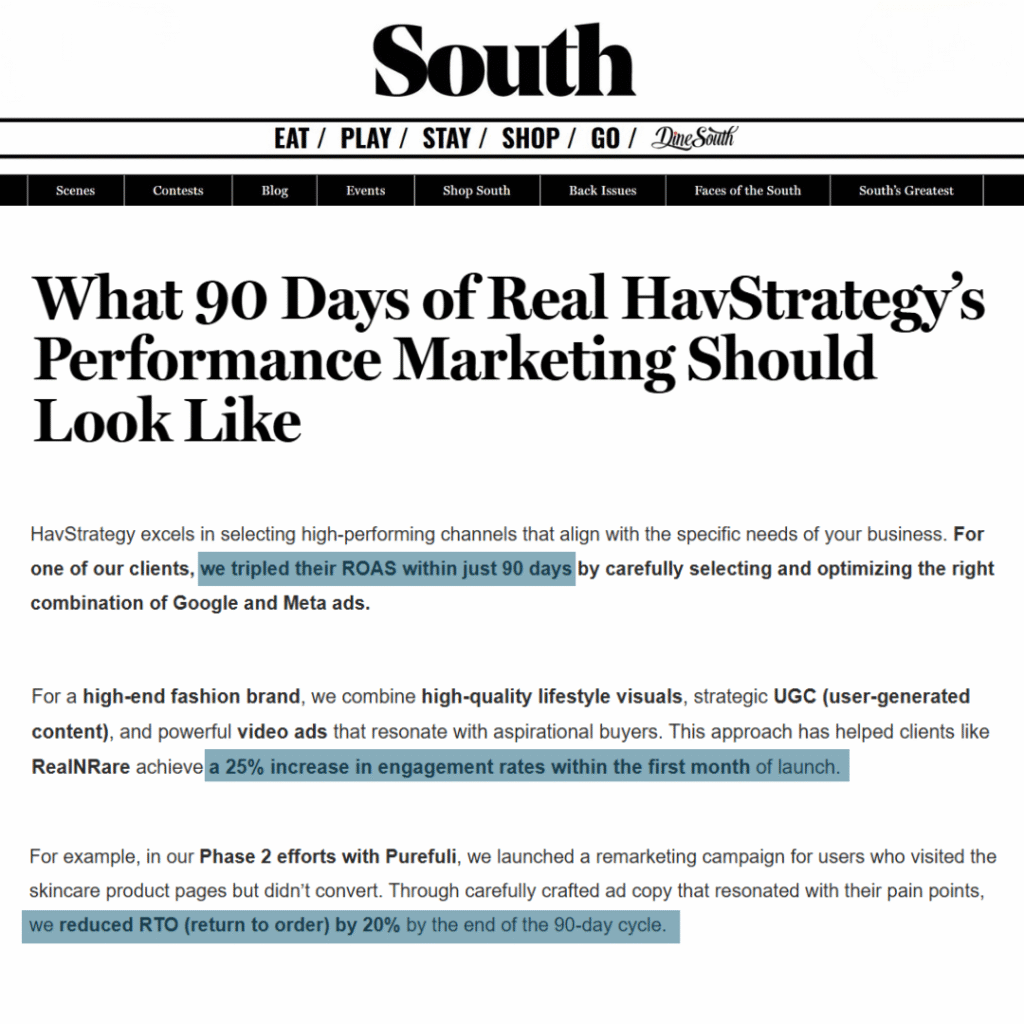
Website development and performance marketing are inseparable for D2C brands in the US because Meta and Google ads spend money driving traffic to your website — and if the landing experience is weak, the paid media performance suffers regardless of how well the campaigns are structured. Specifically: landing page load speed directly impacts Quality Score and ad delivery costs on Google; product page content quality determines whether Meta's algorithm can match ads to the right audience; checkout friction inflates customer acquisition cost (CAC) because fewer clickers convert into buyers; and mobile UX quality determines whether the 60–70% of traffic arriving on phones actually purchases. Brands that rebuild their website alongside their paid media strategy typically see ROAS improvements of 2–4× compared to running ads to an underperforming site. HavStrategy integrates website development and performance marketing under one team, so development decisions are made with campaign performance as a primary KPI. Get in touch to audit how your current site is affecting your ad spend efficiency.
Is it worth rebuilding a D2C website in the US if the brand is already generating revenue?
Rebuilding a revenue-generating D2C website in the US is worth it when the current site's conversion rate is measurably below category benchmarks (under 2% for fashion, under 2.5% for skincare), when mobile UX is visibly inferior to desktop, or when the technical foundation is preventing SEO growth. Many founders delay rebuilds because the current site "works" — but a site converting at 1.2% on $200K monthly traffic is leaving $120,000–$160,000 in potential monthly revenue untouched compared to a well-optimised 2.5% conversion rate. The rebuild decision should be driven by a revenue impact model, not aesthetics. HavStrategy conducts pre-engagement audits that quantify the revenue opportunity of a rebuild against its cost, so founders make the decision with financial evidence rather than gut feel. The short answer: if your site is your primary sales channel and it's underperforming the category, the rebuild ROI is almost always strongly positive. Request a revenue impact audit to model the numbers for your brand.
How should a D2C brand in the US brief a website development agency to get the best outcome?
A strong website development brief for a US D2C brand covers six areas: business objective (what does success look like in twelve months — revenue target, conversion rate, organic traffic?); audience definition (who is the primary buyer, what device do they use, what is their consideration window?); competitive reference (three to five competitor or aspirational brand websites that represent the direction, with notes on what specifically works and what to avoid); technical requirements (platform preference, integrations needed — email, SMS, loyalty, subscriptions, reviews); brand assets (logo files, guidelines, approved photography, approved copy or messaging framework); and budget and timeline parameters. The more specific the brief, the tighter the agency's proposal and the fewer mid-project scope changes. HavStrategy provides a structured briefing template to all prospective clients in the US, making the briefing process faster and the resulting build more commercially focused. Request the briefing template as part of a free discovery call.